
Good Enough Is Not Good
The gap between compliant and genuinely accessible is wider than many want to admit.

You can listen to the newsletter here:
Hello everyone, when you’re reading this newsletter, I’m in Dublin attending a transport conference. The Accessible Link has had a big increase in subscribers since the last newsletter from around the world. A warm welcome to everyone of you who is new here. You can read a bit more about me at the end of this newsletter. I also welcome all new subscribers of the RAIL magazine who came here after reading my column. Have a great week!
11% of disabled rail passengers who booked assistance when travelling by train last year received none of it. And that figure has barely moved in three years. The sector looks at that number and calls it a challenge to address. Waiting for assistance at the airport beyond the legally mandated 20-minute limit is a well-known issue for everyone who can’t leave a plane without assistance. And these are current legal requirements that aren’t met, not a gold-plated assistance concept.

The compliance ceiling
Most train operators and airports now understand that accessibility is a legal requirement. The Equality Act 2010 exists. The 1107/2006 regulation, the EU and UK law for aviation, has been in effect for nearly two decades. The CAA publishes accessibility assessment reports. The ORR has Accessible Travel Policies and benchmarking reports on passenger assistance delivery. Progress, technically.
And yet. In 2024/25, 11% of passengers reported they received none of the assistance they had booked. Independent of the “inconvenience this causes” (a term I would immediately delete from any comms in the railway industry), it has such an underestimated impact on disabled people, mentally and physically.
The worst train operators or airports named in the ORR or CAA reports didn’t fail disabled passengers because they were unaware accessibility mattered. They failed because good intentions and legal minimums are not the same thing as reliable delivery. And not even the legal requirements are always met. In German, there’s an idiom that translates “Where’s no claimant there’s no judge”, and that seems to be the case far too often. So nothing happens even when the law is not followed.
Still, compliance is a floor, not a ceiling. The sector continues to treat it as the destination.
Attitude is the infrastructure nobody wants to fund
I’ve been in situations where the ramp arrived, the staff member turned up, the booking was correct, and the experience was still awful. Not because anything went mechanically wrong, but because the person assisting me made clear, in words, tone and body language, that I was an inconvenience. Once, I was even shouted at when the train arrived and the door opened before I even said a word because I was in the wheelchair space, and the staff member was very upset that he had to carry the ramp all the way to the wheelchair space carriage. Yeah, a ramp needed for the accessible carriage. What an inconvenience!
This is the thing the benchmarking reports can’t fully capture, though the research is starting to try. A recent academic study on airport accessibility found that attitudinal barriers emerged as a distinct and significant theme in disabled passengers’ experiences, separate from physical, service, and communication barriers. The very act of receiving assistance service led some passengers to perceive negative interactions from staff and “othering” from other passengers.
In aviation, the Aviation Accessibility Task and Finish Group’s 2025 report recommended mandatory disability equality training for all aviation staff, developed with disabled people. That’s long overdue. But training changes knowledge; attitude change requires something harder, which is genuine contact with disabled people’s actual lives, not a module and a tick-box. I’m a huge advocate for getting disabled facilitators for these trainings as minimum. I would even say, nothing else works. People need to speak to disabled people to understand their experiences and be able to ask questions about it.
The operators who get accessibility right have disabled people on their teams, in their design processes, and in their senior leadership teams. That’s not an accessibility initiative. That’s basic organisational sense.
The experience, not just the service
The key questions are: is the accessibility provision seamless for a disabled person who has no idea about what’s happening in the background? Is it comparable to the seamless experience of non-disabled people? Or is it a visible, effortful, special process that marks out the disabled passenger as different at every step?
Great accessibility design dissolves into the experience. The step-free route is also the most direct route. The assistance booking confirmation includes all the information you actually need, not just a reference number. The staff member at the other end already knows you’re coming and what you need.
What normally happens is that disabled passengers carry the mental load of the entire system: remembering to book ahead, remembering which entrance to use, where the meeting point is, explaining their needs at every handover point, advocating for themselves when something goes wrong. The passenger does the work that the operator hasn’t done.
There is currently no comprehensive data on how often failed assists occur on rail, especially when the passenger has not booked ahead. When you measure something properly, you have to take responsibility for it.
If the experience requires the passenger to carry knowledge and mental load no non-disabled passenger has to carry to make it on a train or plane, the system has failed. So, involve disabled people in testing from the beginning, not as a final check, including when designing staff training. Training developed without disabled input tends to teach what non-disabled people imagine disability looks like.
Require your assistance staff to be trained before they interact with passengers. This should be obvious. The fact that train operators still have untrained passenger-facing staff 6 years after it became mandatory is frankly scandalous. And no customer cares if they work for an agency or are directly employed.
Measure attitude of staff, not just delivery. The ORR has said it will evolve the framework to include new metrics such as passenger confidence post-assistance. That’s the right direction. Confidence is an outcome. It tells you whether the passenger felt safe, respected, and capable of travelling independently, which is the whole point.
And stop treating “no complaints” as evidence of good performance. Disabled people often don’t complain because they’ve learned it changes nothing and because they have so many reasons to complain, they wouldn’t do anything else. Silence is not satisfaction.
Some interesting links
The UK rail regulator ORR has accepted an improvement plan from West Midlands Trains (WMT) after finding its first submission insufficiently robust. The plan, resubmitted in May 2026, sets out 12 months of actions to fix unreliable passenger assistance for disabled people, including new oversight dashboards, internal customer action groups, and a feasibility study for a dedicated passenger assistance control desk. ORR will hold WMT to monthly progress updates and meetings, warning it expects “meaningful improvements” in the experience of disabled passengers.
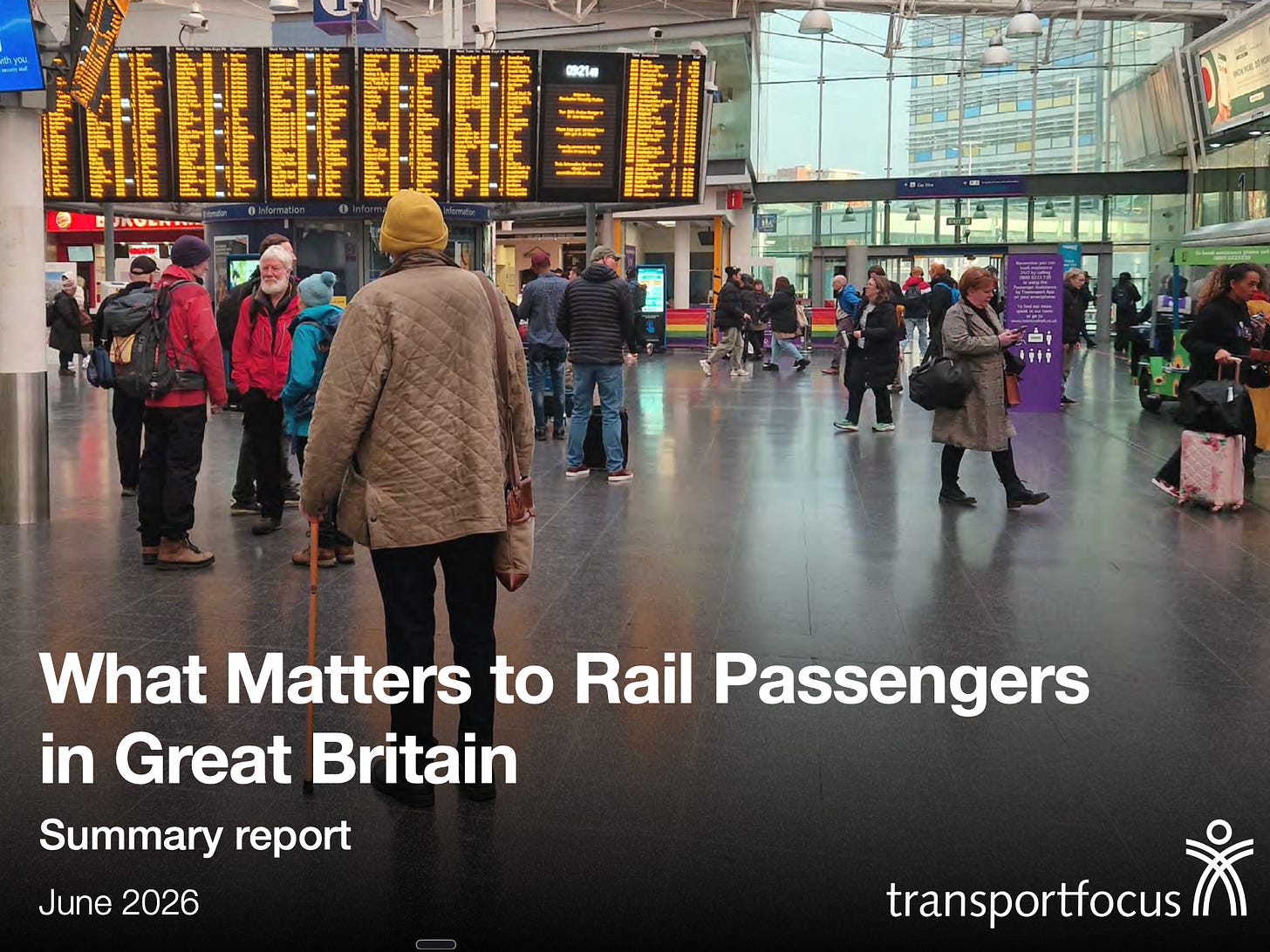
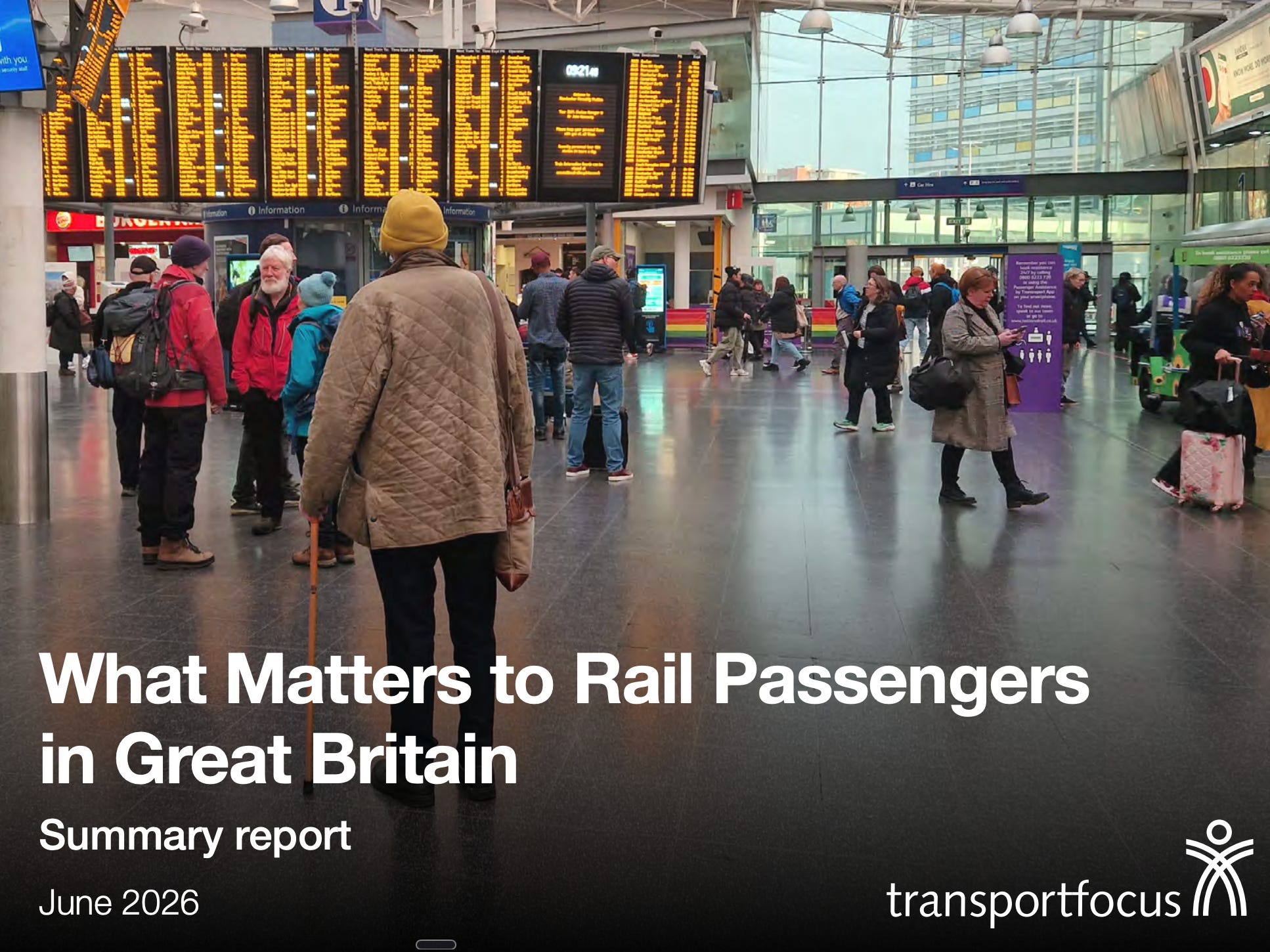
Transport Focus has published its research after asking more than 12,000 rail passengers across England, Scotland and Wales what matters to them. The research provides a ranking for various aspects of travelling by train,
including accessibility.
Hundreds of new, electric buses are coming to West Yorkshire. Each bus will have two wheelchair spaces, flexible space for pushchairs and luggage, and USB charging points.
The Sign Language Bill in Northern Ireland has passed the final stage, meaning British Sign Language (BSL) and Irish Sign Language (ISL) will be recognised as languages of Northern Ireland.
Something to watch
Get a first look at London's new Piccadilly line trains as they prepare to hit the tracks. I especially like the new wheelchair space. It’s spacious and easy to manoeuvre in.
Bits, Bobs & Jobs
The Ministry of Justice is searching for an Accessibility Specialist.
The Department for Science, Innovation and Technology is searching for a Head of Digital Confidence and Accessibility.
Oversharing about your child’s disability has become a lucrative trend on social media. For disability justice advocate Rebecca Cokley, these videos look an awful lot like a modern-day version of the old circus “freak show.”
I just finished “This is for everyone: The unfinished story of the World Wide Web” by Tim Berners-Lee - My rating: 5/5 - Amazing autobiography and biography of the internet. Chapter 8 is about accessibility (with a special mention of Shadi Abou-Zahra, a wheelchair user and accessibility evangelist I know from Austria). There is also a chapter about the London 2012 Olympic Opening Ceremony, an experience we share. I absolutely love this book. If you’re interested in the internet and its history, this is your book too.
Some final words
The Accessible Link is a reader-supported publication.
Who is writing this newsletter?
I’m Christiane Link, and I improve the customer experience in aviation, transport, and travel. I worked as a journalist for over two decades and travelled extensively for business and leisure. I’m a wheelchair user.
Work with me
Whether you're a Customer Service Director, a Head of Customer Experience, a corporate Accessibility Manager, a DEI leader, a transport planner, or a member of a disabled employee resource group, I can help you make your organisation more inclusive. You can book me for speaking engagements or hire me as a consultant for your accessibility or DEI strategy, communications advice and other related matters. I have worked for airlines, airports, train operators, public transport providers, and companies in other sectors.
If you want to read more from me, follow me on LinkedIn, Twitter, Bluesky or Mastodon. You can also reply to this email if you want to contact me.
.
Accessibility policies fail in a very specific place: the handover between the people who write them and the people who deliver them. This piece really highlights that execution gap!