

You can listen to the newsletter here:
Hello everyone, I’m just back from a week in Berlin, and it was a really interesting experience, one that began to unravel before we had even left London.

I had booked assistance, but at the station I was told the lift at London Bridge had been out of service for days. Nobody had contacted me. We had planned our journey to Heathrow as carefully as we could because my partner, who is blind, was travelling with his guide dog. We had two suitcases, and I am a wheelchair user with Triride.
The Easiest Route
Of course, we wanted the easiest route to Heathrow, not much walking, not many lifts because we needed space. That was meant to be via London Bridge, travelling to Farringdon and taking the Elizabeth line. Thameslink is step-free between London Bridge and Farringdon too, and the distances for changing trains are relatively short. But the whole plan fell apart when we realised the lift at London Bridge was out of service.
They suggested that we go via Waterloo East instead. Waterloo East is difficult because it has quite a steep ramp. I would never choose this route unless I had to, because the ramp rises like a wall in front of you. It was clear that we would need additional assistance to get up it with the two suitcases. I cannot go up that ramp without holding the handrails and pulling my wheelchair upwards because it is so steep, even with a powered wheelchair attachment. But that is not possible when I only have two hands. If I have a suitcase on top, I need to pull it beside me while holding on to it.
Everything falls apart if the lift is broken
This highlights something important: even when disabled people plan, book and do everything they possibly can to make a journey as easy as possible, the moment a lift breaks down, or anything fails to go to plan, everything else falls apart.
We then had to change to the Underground at Waterloo to get to Bond Street. We had tried to avoid the Underground in the first place because it has less space than a Thameslink train, and because of the long walking distances and several lifts at Bond Street. But we had no choice. Even a taxi would not have saved us, because fitting all of us, the suitcases, the dog, the wheelchair and the Triride into a black cab would have been very difficult. That was not an option either.
We mitigated because nobody else did
So we took the Tube. We walked the distances. We mitigated Great British Railways' not-so-greatness.
But what I want to highlight is that I can plan as much as I can, and it still isn’t enough.
When we finally arrived at the gate, I checked in my Triride as I always do. I put it in a suitcase. I folded it down and placed it inside a hard-shell suitcase to protect it from damage during loading. The dispatcher for this flight did not like that. Of course, I had removed the battery. The battery was within IATA rules for maximum battery size. I had it with me, safely stored in a fire-protective pouch. The check-in agent checked everything as well, but apparently he wanted to tell me I can’t travel like that. I did it many times before, always with BA.
The Mobility Aid in a Suitcase
The dispatcher told me that I could not check in a Triride. He said that if I put it in a suitcase, it no longer counts as a mobility aid, which is not true. And because it’s no longer an aid, the battery regulation doesn’t apply. So I am not allowed to protect my mobility aid from damage?
I will contact BA now because I had the same discussion on the way back. They didn’t want me to check in my Triride, even though doing so makes their job much easier. It is easier to load a suitcase than to load a very fragile aid with a display, braking handles, and an accelerator button sticking out, without a protective case.
That is why I did not want to get it loaded at the gate but at check-in in a suitcase. They cannot even transport wheelchairs without damaging them, and my wheelchair is quite sturdy. I don’t think my Triride would survive that. Or at least it would be a high risk I don’t want to take.
There is no issue either. The Triride fits inside a suitcase. In Berlin, I take it out and use it, then put the battery back in, and the battery fits in my handbag and is stored in a fire-safety pouch. Without the battery, the Triride is just a bit of metal and plastic cables, no battery or anything that can switch it on.
Energy-consuming
These debates and all these challenges during a journey are so energy-consuming.
Then, to make things worse, there was a rail replacement service between Berlin Airport and Berlin city centre. But there was no bus, no staff and no sign. We were lost in the middle of Schöneweide, which felt like the middle of nowhere, or at least that was how it looked to us because we had no idea where we were.
We found a tram and got on. Then we got off at a stop marked as having an S-Bahn connection and took the train from there. But there was no support. Again, we had two suitcases, a Triride, a wheelchair, the dog, my blind partner and me.
It was all a bit much.
The trip did not begin in a very relaxing way. In the end, though, we had a great week. Even though we stayed in three different hotels for several reasons, everything was fine. I knew the airport hotel from several past trips, but not the others; still, they were actually okay. Not perfect, but okay. The staff were very nice too: welcoming towards the dog and towards us. That made such a difference.
But a relaxed, uneventful journey still seems like Mission Impossible.
Some interesting links
Using public transport among older adults is linked to lower mortality.
Surrey Quays and Northolt stations in London have opened new step-free entrances last week, improving accessibility for the Windrush Line and Underground. Northolt will be the 95th station on the Tube network to offer step-free access. At Northolt (Central line), a new footbridge from the ticket office to the platform has been built, along with a new lift. Manual boarding ramps are also available, meaning step-free access is now available from street to train. Two accessible toilets will also be provided as part of the improvements and will open shortly.
A third of Tube stations across London are now step-free, and more than half of London Overground stations and all Elizabeth line stations, DLR stations and tram stops offer step-free access.
Work is due to be completed in summer 2027 to make Leyton station (Central line) step-free and has started at Burnt Oak station (Northern line). In addition, 45 Tube stations currently have step-free access feasibility or design work underway, including Alperton and Eastcote, both of which are progressing toward the end of the design stage.
In celebration of the 37th anniversary of the Air Carrier Access Act (ACAA), the U.S. Department of Transportation (DOT) has launched a campaign, #AccessibleAirTravel, to raise awareness about the right of disabled passengers to safe, dignified, and accessible air travel.
Something to listen to
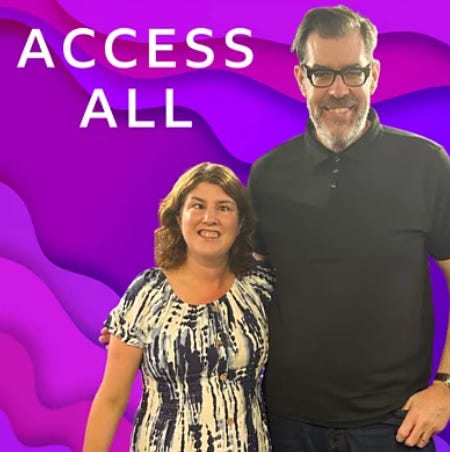
Bestselling author and TV presenter, Richard Osman, is visually impaired due to the eye condition Nystagmus, and he tells the Access All podcast, “the world is just blurred to me”.
In this wide-ranging chat with Emma Tracey, Osman describes why his visual impairment sends him into panic mode at airports.
Bits, Bobs & Jobs
Leeds City Council is searching for an Inclusion Advisory Team leader.
Mencap are searching for a Head of Quality Assurance.
Motability are searching for a Policy Manager.
There is little appetite for cuts to disability benefits even among Conservative and Reform voters, and proposals to reduce spending could prove politically risky, according to an authoritative national survey, reports “The Guardian”.
Did the recent heatwaves negatively affect your health? Home? Finances? Medication? Care?
The Disability Rights UK Heatwave Survey is now online.
Some final words

The Accessible Link is a reader-supported publication.
Who is writing this newsletter?
I’m Christiane Link, and I improve the customer experience in aviation, transport, and travel. I worked as a journalist for over two decades and travelled extensively for business and leisure. I’m a wheelchair user.
Work with me
Whether you're a Customer Service Director, a Head of Customer Experience, a corporate Accessibility Manager, a DEI leader, a transport planner, or a member of a disabled employee resource group, I can help you make your organisation more inclusive. You can book me for speaking engagements or hire me as a consultant for your accessibility or DEI strategy, communications advice and other related matters. I have worked for airlines, airports, train operators, public transport providers, and companies in other sectors.
If you want to read more from me, follow me on LinkedIn, Twitter, Bluesky or Mastodon. You can also reply to this email if you want to contact me.
.