
When the System Fails, Don’t Blame the Passenger
The quiet cruelty of blame-shifting

You can listen to the newsletter here:
I have noticed a particular pattern in transport, and once you see it, you cannot unsee it. A wheelchair user has a failed assist. The first question is “Have you booked?” A Deaf passenger misses an announcement about a platform change. The response: “Well, it was clearly communicated.” A blind passenger needs assistance, but the ticket office is not staffed. The response: “The staff was on the platform; he could have searched for us.”
Notice what all of these responses have in common. The system fails. The passenger is blamed.
This is a pattern. It is one of the most damaging dynamics in transport accessibility today when it comes to disabled passengers.

What Blame-Shifting Actually Looks Like
Blame-shifting in transport rarely arrives as outright hostility. It is far more subtle than that, which is part of why it persists. It hides inside policies, scripts, and processes that were designed to protect the organisation rather than serve the passenger.
It sounds like this:
“You should have pre-booked assistance.”
“Our staff followed the correct procedure.”
“The information was available on our website.”
“We can’t be held responsible for our agency staff or contractors.”
None of them is an acceptable response to a disabled passenger who was unable to travel, was stranded on a platform or on a train or plane, or was publicly humiliated in front of other passengers.
What these responses do is shift the burden of a systemic failure onto the individual who experienced it. They tell the disabled customer: the problem is you and your needs, your timing, your lack of preparation. They frame disability as an inconvenience to be managed, rather than a reality the system has a legal and moral obligation to accommodate.
This is the medical model of disability in action. It treats the passenger as the problem to be fixed, rather than examining the barriers the environment has created. And in transport and aviation, where the social model of disability should be the foundation of every accessibility strategy, this is a fundamental failure of understanding.
The Real Cost of Blame
The consequences of this pattern are far more serious than a bad customer experience. They are multi-layered.
It stops people from travelling. When disabled passengers are repeatedly told, directly or indirectly, that their needs are an inconvenience, they stop travelling. Not because they cannot travel, but because the emotional, mental, and logistical costs of navigating a system that blames them for its own failures become too high. This is not a minor inconvenience. This is a restriction of freedom, independence, and participation in society.
It silences complaints. One of the most damaging effects of blame culture is that it discourages disabled passengers from raising concerns at all. If every complaint is met with a response that implies the passenger did something wrong, people stop complaining. And when complaints stop, organisations believe the problem has been solved. It hasn’t. The people affected have simply given up.
It corrupts data. Last week, I received a feedback questionnaire about assistance from a train operator, in which the first question already indirectly blamed the customer. The first question asked if I was 20 minutes before departure at the station. Yes or No? The second question asked if I made a staff member aware that I needed assistance. That was the moment I stopped filling out the questionnaire; even so, I was 20 minutes before departure at the station, and I informed the train operator via WhatsApp that I had arrived via the accessible entrance because it wasn’t near the station building.
When a blame-shifting culture suppresses complaints and even praise (I had a seamless journey on the day the questionnaire referred to), the data becomes flawed. Leaders make decisions based on a picture that does not reflect the lived experience of disabled passengers. Improvements are not made because the problem is not visible, not because it does not exist.
It damages trust permanently. A disabled passenger who has been blamed for a system failure does not forget it. They tell others. They share it on social media. They factor it into every future travel decision. The reputational and commercial cost of blame culture is real, even if it is rarely measured.
Why Organisations Do This
It would be easy to assume that blame-shifting is always malicious. In my experience, it rarely is. It is usually the product of something more subtle: a culture that has never been challenged to think differently. That never uses the experience of a non-disabled traveller as a baseline for what disabled passengers should be able to expect. Nobody asks non-disabled people to show up 20 minutes before departure. We respect non-disabled people’s time.
Staff who respond with blame are often trapped in a failing system. Policies that place the burden on the passenger were never discussed with disabled customers. Customer service processes were designed for efficiency, not equity. And somewhere in the chain, nobody stopped to think: what does this look like from the perspective of the person we are failing? I’ve seen written responses to failed assists that made my blood freeze due to the lack of empathy and the level of defensiveness.
This is why the “Nothing About Us, Without Us” principle is not just a slogan. It is a structural necessity. When disabled people are not in the room where decisions are made, the decisions will reflect that absence. There is also an organisational incentive problem. Admitting that a system failed a disabled passenger means admitting liability, accepting responsibility, and committing to change. Blaming the passenger is easier, cheaper, and requires nothing. Until organisations are held accountable through regulation, through public scrutiny, through legal challenge, many will continue to choose the easier path.
What Genuine Accountability Looks Like
The alternative to blame is not simply being nicer. It is a structural shift in how organisations understand their responsibility to disabled passengers.
It means training staff not just in what the procedure is, but in why the procedure exists, how it helps disabled customers, not just because the regulator says so. It means complaint processes that centre the experience of the disabled customer, not the organisation’s defence.
Most importantly, it means treating disabled passengers as equal partners in the design and evaluation of transport services and not as problems to be managed.
The question transport operators need to ask themselves is not “did we follow the process?” It is “did the passenger get where they needed to go, with their dignity intact and on a level comparable to non-disabled people?”
If the answer to that question is no, then the process failed. Not the passenger.
Thank you, everyone!
Thank you to everyone who took part in my questionnaire. You can still fill it in if you haven’t done so. It gave me some insights into who you are and what you expect from this newsletter. It also gave me good reassurance not to change much, because you are generally quite pleased readers. You like the length of the newsletter in general. So I will not add much. I will add one flexible category, which I call “Bits, bobs and jobs”. That’s where you will find any off-topic links, which I dare to share nonetheless, and some jobs I stumble across and where I think this could interest you. Blind readers asked me to make the link descriptions a bit longer. I will do that as well.
Have a great time!
Christiane Link
Some interesting links
Doug Paulley does it again. He is preparing to formally object to Kent County Council’s decision to approve the diversion of two public footpaths over a proposed railway bridge that will be inaccessible to disabled people. The bridge is intended to link major housing developments on either side of the railway line, including access to a new primary school, community facilities and local amenities, but Network Rail wants to save money and add barriers to the world. They didn’t learn from Copmanthorpe, where Network Rail spent £437,000 on an inquiry to push for an inaccessible footbridge they didn’t build at the end.
Ten years after DISABLED. #SayTheWord went viral on social media, Lawrence Carter-Long reflects on the lessons learned: “Naming disability is not impolite. Nor is it etiquette. It is infrastructure. It is accountability. It is ownership. We do not say the word just to be provocative. We say the word because treating disability as unspeakable has never made anyone safer.”
It is impossible to simulate the experience of impairment and disability in all its complexity, nuance and richness, says Robyn Hunt in “Confessions of a reformed disability simulation enthusiast”.
Something to watch
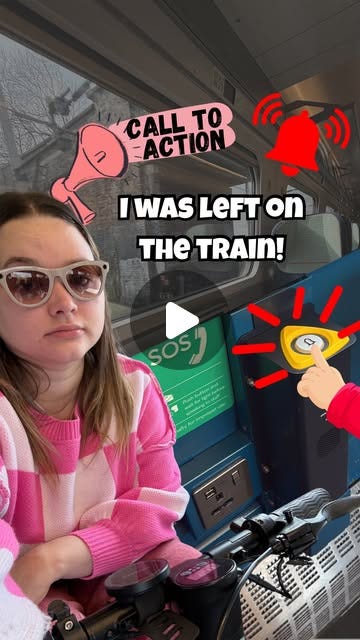
Amy was left on a train, missed a work appointment, and the whole journey took over 90 minutes instead of 38 minutes.
Bits, Bobs & Jobs
“I Swear” has started on Netflix. One of the best films I've watched in decades. If you don’t have Netflix, it’s also on YouTube and Prime for around £4.
East Midlands Airport is searching for a Customer Service and Assisted Travel Manager. I’m biased, but I can say they are an amazing team.
Investment company Royal London is searching for an Accessibility Consultant (customer experience) and an Accessibility Specialist (digital); both positions close this week.
What I’ve just read: Entitled: The Rise and Fall of the House of York, by Andrew Lownie - My rating: 4/5
Some final words
The Accessible Link is a reader-supported publication.
Who is writing this newsletter?
I’m Christiane Link, and I improve the customer experience in aviation, transport, and travel. I worked as a journalist for over two decades and travelled extensively for business and leisure. I’m a wheelchair user.
Work with me
Whether you're a Customer Service Director, a Head of Customer Experience, a corporate Accessibility Manager, a DEI leader, a transport planner, or a member of a disabled employee resource group, I can help you make your organisation more inclusive. You can book me for speaking engagements or hire me as a consultant for your accessibility or DEI strategy, communications advice and other related matters. I have worked for airlines, airports, train operators, public transport providers, and companies in other sectors.
If you want to read more from me, follow me on LinkedIn, Twitter, Bluesky or Mastodon. You can also reply to this email if you want to contact me.
.